There was one image that did it. Every time I looked, the smell of the harbor, the wind rushing through my ears, and the sound of the hull breaking through the water transported me right back onto that boat.

Not long after capturing that memory, in a rare moment of financial responsibility, I sold the camera.
The Fujifilm X100VI, while a fine piece of kit, didn't fill enough of my actual needs. It sat on my dresser looking sexy, gathering a light coating of dust. I would pick it up from time to time to wipe it down, turn it on, and look through the viewfinder, but I eventually stopped carrying it every day in lieu of my full-frame Sony.
I always felt a strange tinge of guilt when I reached past the Fuji. The Sony was just too good. Its autofocus is straight sorcery—basically laser beams.
To demonstrate to my wife that I was being prudent, I listed the X100VI on the secondhand market. She was happy, and I felt a strange relief—suddenly freed from gear paralysis and that lingering camera guilt. She was happy, and I felt a strange relief—suddenly freed from gear paralysis and that lingering camera guilt. Everything was good. For a little while.
The Obsessive Backup
I have always had a tendency to make contingencies and backups for the backups—a byproduct of an obsessive mind and a massive, ever-looming fear of failure. For years, I burned photo catalogs onto DVDs before progressing to external hard drives.
That stubborn habit of keeping my options open extended to the X100VI. It allows for simultaneous RAW and JPEG recording. In spite of my aging laptop's audible complaints, I shot both.
Now that I'm in my fifties, falling back asleep after waking up in the middle of the night is a challenge. Lying in bed trying to think of nothing typically starts me down the path of something. On these nights, I slip out of bed, open my laptop, and edit photos. I gravitate toward photography because it satisfies both sides of my brain; it is the perfect collision of technical proficiency and artistic vision.

Fujifilm X-100VI using the original Classic Cuban Negative JPEG recipe by Osan Bilgi. Austin, Texas

Fujifilm RAF (RAW) file edited in Lightroom using my CCN preset utilizing Adobe Color profile. Austin, Texas
Reverse-Engineering the Magic
A few months after selling the X100VI, I stumbled across that Staten Island Ferry photograph during an early morning session. A crazy idea struck me: Could I reverse-engineer Fujifilm's "Classic Cuban Negative" recipe for my Sony RAW files? Better yet, could I create a preset that would reproduce that look across different camera systems?
Developed by Osan Bilgi, that specific recipe—with its deep reds, vibrant colors, and beautiful contrast—became my go-to when I returned to photography after a 12-year hiatus. In fact, it was the exact profile dialed into my camera on the ferry that morning, burning those deep tones into the memory of the ocean wind and the hull breaking through the water. A massive selling point of Fujifilm cameras is their "baked-in" film simulations. The images look incredible straight out of the camera without requiring years of editing experience.
Suddenly, my obsessive backup habit became an asset. Because I had saved both formats, I could sit at our scuffed kitchen table before dawn and after work every night, making micro-adjustments to the original Fujifilm RAW files using their corresponding JPEGs as side-by-side references.
Countless slider and curve adjustments followed. To make matters more complicated, I was starting with Adobe's color profile and trying to recreate the colors and tonal rendering of Classic Cuban Negative—a custom recipe built on Fujifilm's Classic Negative film simulation. Hours turned into weeks. Weeks turned into months. Version after version.
Luckily, I had saved hundreds of matching RAW and JPEG files to cross-reference each new iteration against different scenes—building exteriors, skin tones, glass, and foliage.
But I wasn't satisfied with just matching old files. I wanted to know whether the preset would hold up against new photographs, particularly when applied to my Sony RAWs. So, in another questionable exercise of financial restraint, I bought a Fujifilm X-H2.
Having both camera systems allowed me to photograph the same subjects side by side, compare the Fujifilm JPEGs against the Sony RAW files, and continue refining the preset until I was satisfied.
Then came the payoff. It finally worked. The preset didn't just capture the essence of the original recipe; to my eyes, the results were nearly indistinguishable from the Fujifilm originals. I had lost the camera, but I kept the magic.

Fujifilm X-H2 with Sigma 17-40mm f/1.8 using the original Classic Cuban Negative by Osan Bilgi

Sony A7RV with Sony 24-50mm f/2.8 using my CCN Lightroom Preset
Finding My Own Palette
An obsessive mind never stops. Most times, it's exhausting. I'm rarely satisfied, and there's always something else to explore, something else to improve. They say wisdom comes with age. Maybe I've finally learned to turn some of those tendencies to my advantage. The countless hours spent tinkering with Lightroom taught me more about the software than all my previous years using it.
Although I enjoy shooting all types of imagery, architecture remains my strongest genre. Perhaps it's simply the way I see the world. The geometry, rhythm, and contrast of buildings are strangely calming to me. Maybe they bring a little order to the disorder of everyday life.
As much as I loved Classic Cuban Negative, I began to notice its limitations. The very colors and contrast that initially drew me to the recipe didn't always complement the architectural subjects I gravitated toward. I found myself wanting something a little different. Something that felt more like my own.
Using my new Lightroom preset as a starting point, my early mornings were once again occupied with sliders and tone curves. I found myself drawn toward a more desaturated palette with stronger contrast—something that better complemented the structures I wanted to capture.
After countless revisions, something distinct began to emerge. Concrete became creamy, blues shifted toward cyan, and colors grew softer and more muted. The contrast remained, but the overall palette became more restrained.
Eventually, I had something that felt like me.

Bahá'í House of Worship, Wilmette, Illinois

Tower at Pier 27 condominium complex, Toronto, Canada

Financial district downtown Toronto, Canada

Financial district downtown Toronto, Canada
Classic Patina
I named the new preset Classic Patina. It reminded me of the weathered surfaces of ancient Greek and Roman ruins, where centuries of exposure had softened the colors and revealed the imperfections beneath. There was a certain beauty in that passage of time, something I wanted to bring into my work.
To my surprise, Classic Patina worked across the different subjects I loved documenting—architecture, street scenes, automobiles, and ordinary daily moments.
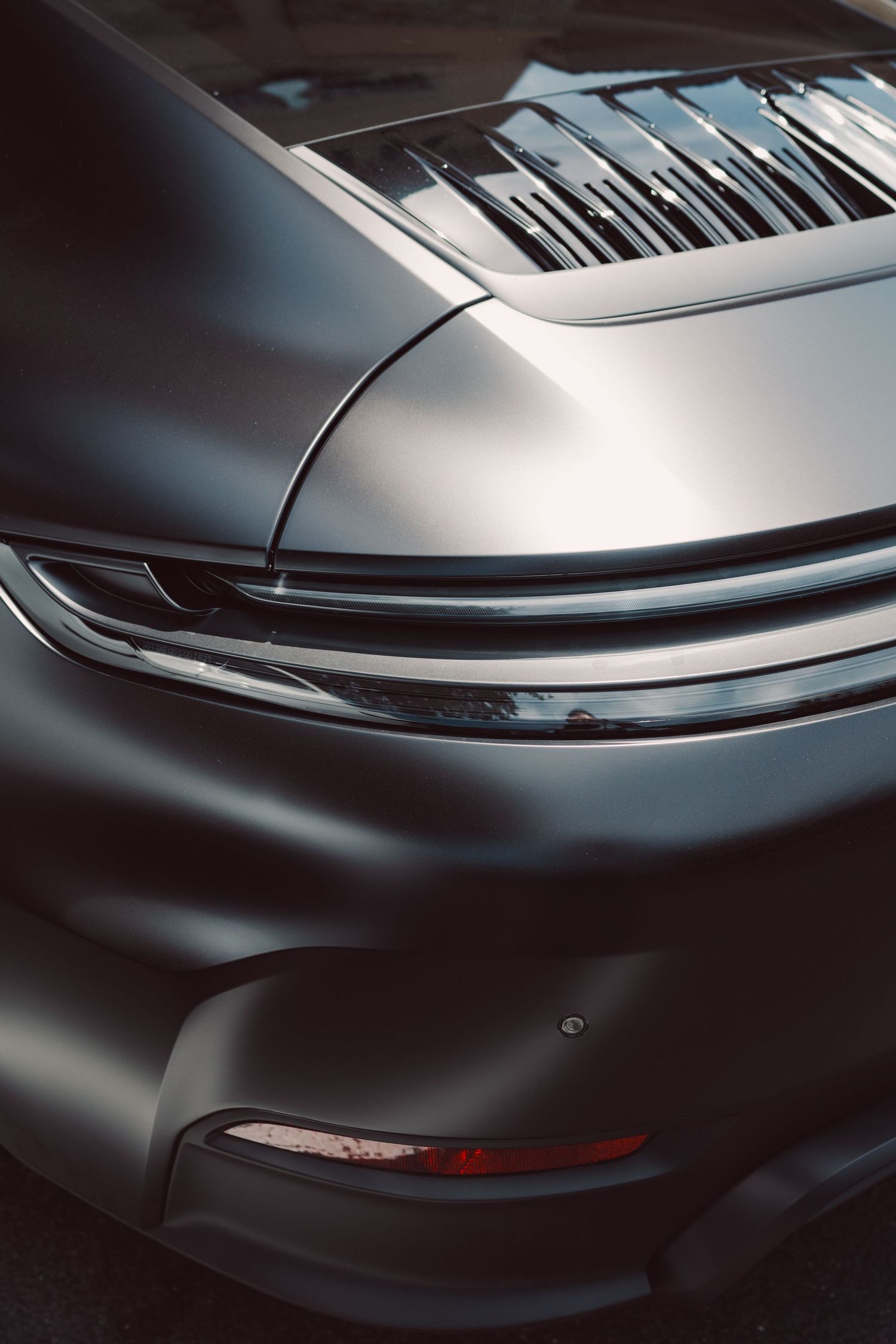
Porsche 911 rear quarter detail

Jack Layton Ferry, Toronto, Canada

Fifth Avenue, Manhattan NYC

Marian Shrine of Our Lady of Schoenstatt, Austin, Texas

Street photo Toronto, Canada
I still have trouble sleeping. Some nights, I lie awake trying desperately to think of nothing. But I've come to realize that sometimes, in the process of thinking about nothing, I end up creating something.
Classic Patina was one of those somethings.
